Summoning an Edwardian Lady
Memories and visions from a stroll down West Franklin Street
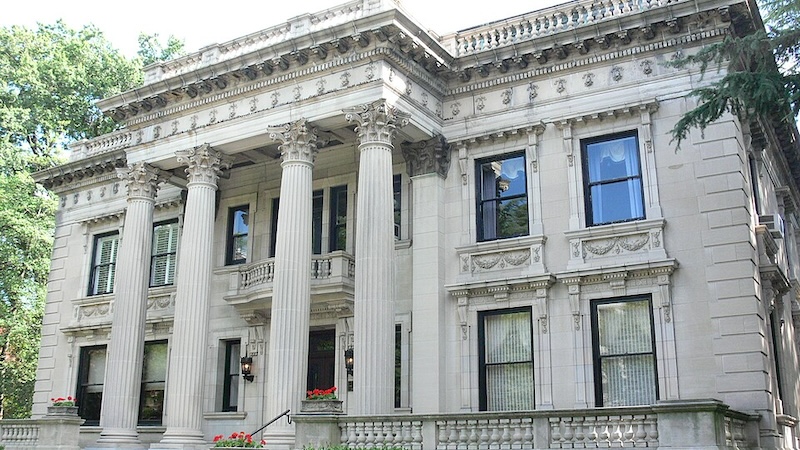
When Richmond writer Martha Steger walks down a historic block in her city of Richmond, she recalls interviewing an influential, cosmopolitan Edwardian lady in her Beaux Arts-style house. Steger summons the woman and the house in From Our Readers.
As summer fruit stands spring up along every two-lane road, I summon the memory of my maternal grandfather’s large watermelon patch. He pulled a hundred melons for an annual August Sunday watermelon party – and he did it as an Edwardian gentleman in a starched white shirt early in the morning, despite being a Monday-through-Saturday dirt farmer.
Smells, according to science, trigger the strongest memories, but sights trigger strong ones for me as well. Every time I walk down the 900 block of Richmond’s West Franklin Street I recall interviewing the influential Edwardian-era-born civic leader, preservationist, and philanthropist Elisabeth Scott Bocock (1901–1985). The Beaux-Arts-style house built by her and her husband, Frederic Scott – sitting among several early Colonial Revival-style houses on the block – makes me think of that complex woman known for her dynamic energy and deep commitment to preserving her city’s architecture.
In its day, the Scott house stood out among the collection of brownstones that distinguished the city’s environment, just as Scott-Bocock stood out among area preservationists. In keeping with that sense of preservation, she told the anecdote of sitting down on the train out of Richmond for her honeymoon on May 3, 1928, when her new husband addressed her as “Lizzy.”
“I told him that if he were going to call me ‘Lizzy,’ I would immediately be off the train. ‘My name’s Elisabeth,’ I said – and he never called me Lizzy again.”
Lest I forget this Edwardian woman’s complexity, the Scott house reminds me that its style was cosmopolitan for Richmond in that era. Designed by Richmond’s leading architectural firm at the time, Noland & Baskervill, the home sported the classical composition popular in turn-of-the-20th-century New York.
I would remember the style decades later when I visited Paris for the first time, seeing, on the grounds of Versailles, the Petit Trianon – the model for the Scott house. Still later, as a “friend” of the Norfolk Public Library, I would visit the city’s first free library – established in 1870 but opened with Carnegie money in 1904 – whose design was inspired by that of the Scott house. Much later, I would see the Marble House in Newport, Rhode Island, another such inspiration.
The 20th and 21st centuries have often showcased ‘upscale’ fashion; but the late 19th-century Scott house, like the Jefferson Hotel eight blocks east, was the upscale project on Franklin Street that always reminds me of a cosmopolitan Edwardian woman.
Midlothian-based freelance writer Martha Steger is a Society of American Travel Writers’ Marco Polo member. For 25 years, she was public relations director for the Virginia Tourism Corporation.
FEATURE PHOTO, TOP: The Scott House in Richmond, Virginia, listed on the National Register of Historic Place. Image by Morgan Riley. Link to license
Read more like Martha Steger’s memories of the Edwardian lady and other contributions from Boomer readers in
Do you have your own stories you’d like to share with our baby boomer audience? View our writers’ guidelines and e-mail our editor at Annie@BoomerMagazine.com with the subject line “‘From Our Readers’ inquiry.”