The Flower Children of Matala
‘Old scratchy rock ’n’ roll playing beneath the Matala moon’
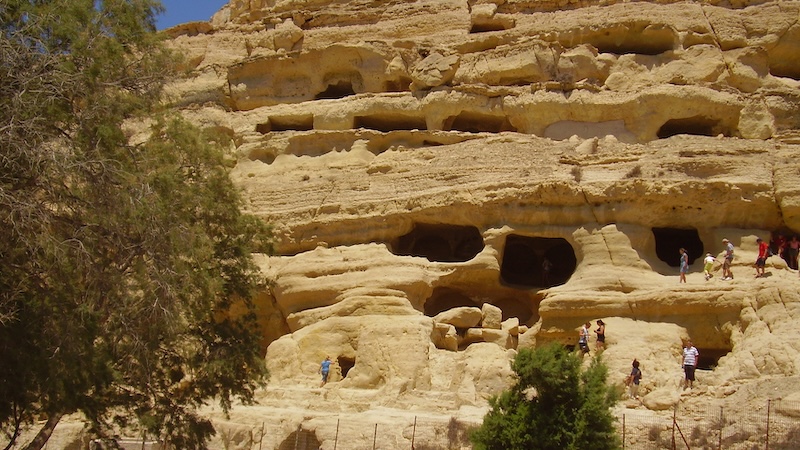
The caves at Matala hold centuries of tales. Travel writer Sherri Moshman-Paganos describes more recent visitors, including the flower children of Matala, Greece, in the mid ’60s until early ’70s.
The caves at Matala lie empty and silent at night, but in the mid ’60 until early ’70s they were alive, inhabited by hippies, mostly Americans and western Europeans. In 1971 when Joni Mitchell sang in “Carey,” of “old scratchy rock ’n’ roll playing beneath the Matala moon,” she brought fame to the cave inhabitants. Until its “discovery,” Matala had been a sleepy isolated fishing village on Crete’s south coast.
Joni Mitchell wasn’t the first to call attention to Matala. A few years before, in September 1967, with the headline Beatniks Build an Eden in the Caves of Southern Crete, a Washington Post article describes a cliff, “pockmarked with caves … that has become the refuge of droves of European and American beatniks.”
Beatniks, hippies, flower children, they were searching for an alternative way of life, which they found in Matala, a town still thriving on flower power nostalgia.
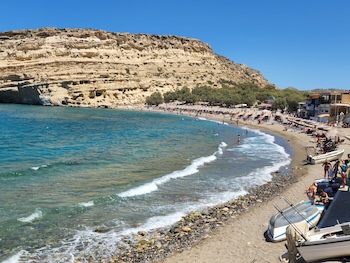 As we approach in our rented blue Suzuki, before us lies the shimmery sea and horseshoe shaped beach near the “pockmarked” caves.
But first we head for Mama’s Bakery. The pleasant young woman inside finds one remaining tiropita left for us. As she wraps it up, we show her a photo. Her eyes widen with surprise and then tears. “My grandmother! How did you know her?”
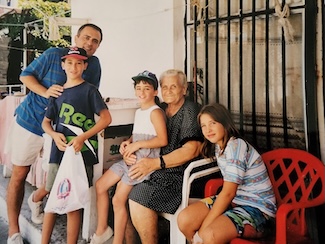
1998: family vacation when we met her grandmother, known as “Mama of Matala.” Anastasia, who runs the bakery, is the granddaughter, the little girl in the red chair.
I was curious to meet Mama, known for taking care of the hippies. In her early 80s, she had a sweet angelic smile, with her long white hair pulled back in a bun. Inside the bakery, she wiped her hands on her apron, untied it and led us outside to talk.
According to Mama, counterculture Greeks first came before the caves were discovered by foreigners, mostly Americans.
 On her part, she baked bread every day and gave it to the “flower children,” along with sandwiches and yogurt, collected their mail, and “some who had money asked me to hide it for them,” she told us. “I looked after them, however I could.”
“The villagers were not happy about them being there,” she told us. “They said they were dirty and had drugs. With the dictatorship, the police went after them, so they kept moving higher and higher up in the caves. There were five levels. And finally the police made them all leave.”
This was in the early ’70s during the military junta. In 1975, when my husband first visited Matala, the only hippies left were sleeping on the beach, like him and his friends, under the almerikia, the salt cedar trees you see everywhere on Greek beaches.
I asked Mama if she ever got visitors from the past. “Oh yes! Many hippies became successful lawyers, doctors, university professors.” And over the years many have returned to visit. “They’ve never forgotten me!” she said proudly.
Years later, Anastasia’s children help out in the bakery, still pretty much the only one in town.
The often strong wind is blowing sand into our faces. Time to get up to explore the caves. A fence with the sign “Roman Cemetery” emphasizes when the caves were used for Greek and Roman tombs. At night it’s locked, no staying in the caves allowed.
Before they were used as tombs, this honeycomb complex, carved out of the soft sandstone cliffs in the Neolithic Age, was probably used as prehistoric places of worship. Later, early Christians hid there from the Romans. In the Middle Ages, the site was used as a leper colony.
In Matala, Zeus, disguised as a white bull, carried the princess Europa across the sea from Phoenicia. Here he regained his human form and mated with her “under an evergreen tree.”
Zeus knew a beautiful beach, along with the flower children centuries later. The view from up in the caves of the beach and town across is stunning.
Newcomers probably had either the highest level or the lowest to the sea, vulnerable to storms. Inside, the “residents” set down sleeping bags on the natural tomb slabs. Some impressive “suites” were reserved for those more respected in the community.
On the same level are giant thrones, chairs chiseled out of the rock, maybe where senior members sat. “Freedom” is scrawled in a cave in big letters.
In “Carey,” Joni Mitchell sang about the Mermaid Café, where “I will buy you a bottle of wine / and we’ll laugh and toast to nothing and smash our empty glasses down.” Of the two cafés on the beach then, the Delfini Café had the scratchy rock ’n’ roll but the Mermaid was the main hangout. A cave dweller describes how it was there:
corrugated faces hunched over kerosene lamps and candles, samples of all the migratory hordes gone A.W.O.L. from the anthills of the world: campus Guevarists in Fidelista fatigues, sexual Leftists and sanyasins in long-flowing robes…
After sunset, the clubs and bars on Matala’s main street fill with music. The caves though stay silent with their secrets, and the moon and stars shine in the Matala night.
Based in Athens, Greece, Sherri Moshman-Paganos is a writer and former educator who writes about her travels in Greece and beyond in https://olivesandislands.com/.