Grieving Cats and Friendly Feral Feline
Can cats suffer at the loss of a family member?
After a woman’s husband died, their two cats exhibited behavior changes, including urination issues. Another writer tells of an overly friendly feral cat whose darting behavior are a fall risk. “My Pet World” advisor Cathy M. Rosenthal addresses grieving cats and taming the feral feline.
Dear Cathy,
I hope you can help with my 13-year-old cat, Gracie, who has periodically been urinating on rugs in the house. We adopted her and her littermate brother, Georgie, when they were six months old. Both use the litter box regularly.
About a year ago, Gracie began urinating on a particular rug. My veterinarian ruled out a urinary tract infection and suggested adding another litter box and plug-in pheromones. We did both, and the behavior stopped.
A few months later, my husband died unexpectedly. Both cats became very subdued for several weeks. Since then, they have become much more attached to me and jealous of one another when I am giving attention. Gracie sometimes chases Georgie away, but there were no accidents.
Then, about a month ago, I came home after being out for a few hours. Gracie greeted me at the door, then walked over and urinated on a rug. She stood beside the spot as though she wanted me to see it. The following week, the same thing happened on another rug. This time, she urinated, then came to me purring and wanted to be petted.
I took her back to the veterinarian, who again ruled out a urinary tract infection. She also had a full physical exam and bloodwork. Other than inflammatory bowel disease, which my veterinarian doesn’t believe is related, everything was normal.
Could this be attention-seeking behavior or separation anxiety from grieving cats? Both cats have been such a comfort since my husband’s passing, and I want to help Gracie however I can.
– Jean, Wethersfield, Connecticut
Dear Jean,
First, let me say how sorry I am for the loss of your husband. I’m glad Gracie and Georgie have been a source of comfort during such a difficult time.
One of the biggest misconceptions about cats is that they urinate outside the litter box simply to get our attention or get back at us. Inappropriate urination is almost always a form of communication. Cats are trying to tell us something, whether it’s physical discomfort, emotional stress or a change in their environment.
The loss of your husband changed the emotional landscape of your home, not just for you, but for Gracie and Georgie. We often think of grief as something only people experience, but animals notice when someone important is suddenly gone.
Grieving cats and other pets may become quieter, clingier, more anxious, or even change the way they interact with one another. Grief unfolds over time, and as families adjust to a new normal, stress-related behaviors can emerge weeks or even months later. Gracie’s urinating when you come home may be triggered by a rush of emotion, perhaps excitement, anxiety, or uncertainty. Seeking your reassurance afterward suggests she is turning to the person she trusts most when those feelings become overwhelming.
I would continue providing multiple litter boxes in separate locations, scooping them daily, and keeping the pheromone diffusers since they seemed to help before. Also, I would make time for individual play and attention with each cat so neither feels the need to compete for your affection. I would also buy a litter box attractant to sprinkle in the box to see if that helps.
Most importantly, if the behavior persists or becomes more frequent, go back to your veterinarian. Conditions such as feline idiopathic cystitis, arthritis and other age-related problems can come and go. If Gracie’s behavior is ultimately linked to anxiety, your veterinarian may also suggest medication to help her feel more secure.
Overly friendly feral cat
Dear Cathy,
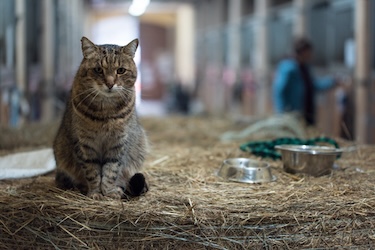 I live on a large farm in Virginia and over the years many feral cats and dogs have come to live here. This Spring, a very young and friendly feral cat showed up and, as usual, I fed it. I got him neutered, all his shots, and tick and flea treatments. He now lives in my barn.
The problem is that he is too friendly. I am in my late 70s and am very careful about preventing falls. Unfortunately, this kitty likes to unexpectedly dart between or in front of my feet and legs making me stumble. It is just a matter of time before he catches me unaware and I fall. Is there any way to teach him not to do this?
– Anna, Amherst, Virginia
Dear Anna,
When a cat displays this kind of behavior, it’s usually because he’s seeking attention or interaction. Since he has learned to associate your arrival with something positive, he is trying to greet you the best way he knows how.
One of the safest ways to manage this is to redirect his attention before he reaches your feet. First, I recommend stopping for a moment when you first get outside or at the barn entrance before walking through your property. So, you can see where he is.
Second, carry a feather wand or another favorite toy with you, and wiggle it off to your side, so as he approaches, he will be more interested in that than your legs. You could also toss a few treats to your side as you walk. Redirecting his focus away from your legs gives him something appropriate to chase while allowing you to move safely.
Third, if he does weave between your legs, always stop until he is finished rather than trying to step around him, which is often when falls occur. Cats usually lose interest once they realize you are not moving. This is also a good time to engage him with the toy or treats again. Finally, consider enriching his environment with things to climb, scratch, and explore. A sturdy cat tree, shelves, or even a few hay bales arranged at different heights can encourage him to spend more time climbing and observing than following you underfoot.
Thank you for taking such good care of him and for getting him neutered.
Cathy M. Rosenthal is a longtime animal advocate, author, columnist, and pet expert who has more than 25 years in the animal welfare field. She addresses reader questions as diverse as grieving cats to bizarre dog behavior. Send your pet questions, stories, and tips to cathy@petpundit.com. Please include your name, city, and state. You can follow her @cathymrosenthal.
©2026 Tribune Content Agency, LLC
As an Amazon Associate, Boomer Magazine earns from qualifying purchases of linked products.