Growing Her Appreciation for Irises
Lessons from her great-grandfather and his flowers
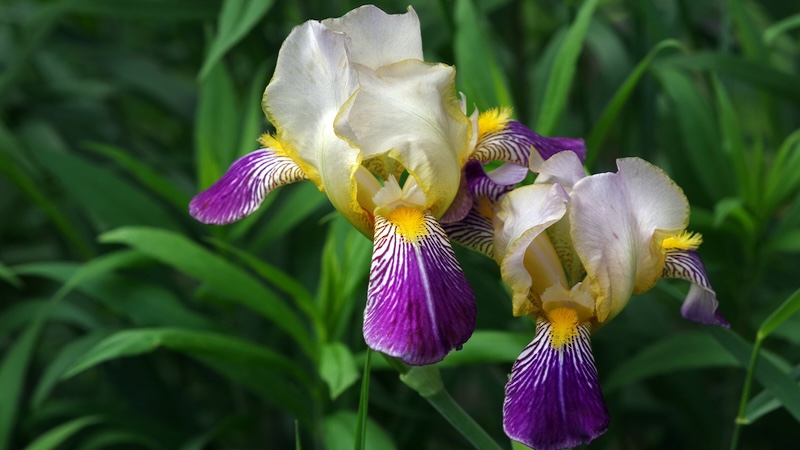
Grief visited teenaged Rae Piwarski, but so did love. She lived with her great-grandmother, Gnamps, and great-grandfather, Tata, who planted and watered her appreciation for irises and other flowers.
I was angry at summer when the iris catalogue arrived. It always showed up before Labor Day. By that time, the cicadas had a whole summer of shrieking behind them. The humidity settled into our decrepit rental like it might stay forever. Like dark magic, purple mushrooms sprouted in the bathroom tile grout.
During my teenage years, I lived with my great-grandfather Tata. I sat bundled up like a babushka in my “bedroom,” which was just the hide-a-bed in the living room, while Tata flipped the pages at his drafting desk.
“What do you think of this, little one?,” he asked me as he held up a page.
“That one’s probably my favorite, Tata,” I shouted, so my voice could reach his hearing aids.
“I think it’s just what we need,” he replied, tapping the purple and white flower called “flash of light.”
When autumn arrived, he told me to go outside with him. He trundled to the backyard with a large bucket of red in each hand. The maple trees sent their brilliant leaves at us like paper airplanes in the wind.
Tata used to build houses but the large red and white house he built on Windy Hill Lane got hit by a tornado so he moved into this rental on acres of wild woodlands in Northeast Ohio. When my father and I became homeless because he was given six months to live and could no longer work, we moved in with Gnamps and Tata so I’d have someone to live with when he died.
My dad slept a lot because he was on dialysis much of each week. Gnamps worked a lot, so I spent most of my time with Tata. He called me Hannah Montana. He said if I had a different life, he bet I would have been a Disney star. “You remind me of those girls, so full of smiles and life.”
In the clearing of the yard where a groundhog shuffled away sat three garden beds that Tata built.
“All the irises will go here. This year I got the flash of light and butter yellow.”
I started digging the holes where he pointed. Then he told me to wait. He pulled out some tattered gloves.
“You should wear gloves all the time. Whenever you clean or work with dirt and chemicals. Once your hands go, oh, they’ll look like mine.”
Come iris spring I decided to go out for the junior varsity softball team even though I never played a school sport in my life. I was absolutely awful. Tata was beaming. He had trouble making it to the games because the bleachers were unforgiving to an almost 90-year-old man, but every sunny day he insisted we go back by the irises to play catch.
He refused to wear a glove, even though I had a spare he could use.
“My hands are wrecked and tough, so just throw it to me, little one,” he said.
He would go clear across the yard because I “played” right field. This meant I let the softball go through my legs and into deep right field.
Each time the ball landed in his weathered hands, I winced. Yet, he insisted. In the daffodil springtime we played catch for hours each day.
After spring turned into a lonely summer, a listless fall followed, then a bitter winter came after that. I woke up on the couch. Instead of going to his room, I found that Tata stayed in his recliner. This happened fairly often. He usually put on Cleopatra or Ben-Hur then passed out. I tapped his shoulder and he fell completely forward, his head and fingertips on the carpet. Next to him, on a small table, sat the iris catalogue, opened to the brightest purple. One week later the January wind joined us at an old Polish cemetery to say goodbye to Tata. A couple springs later the irises I planted at his unmarked grave danced in the summer breeze. They were the last flowers I ever saw in Ohio.
To plant bulbs in the fall means you can still hope for flowers as the world around you dies. You put them in the ground and hand them to yourself much later, when you really need their colors.
Decades later, my small daughter would pick up some bulbs at the store: not irises, but tulips. We would plant all two dozen on a bright fall day. I felt Tata with me. When the bulbs popped up in mid-March I could see him in my garden, a flash of light.
Garden Nostalgia: Five Businesses with Generations of Plant Legacy
Rae Piwarski is a PhD recipient in English literature from UT Austin. She lives in Montana with her husband, children, and many pets. Her other work has appeared in Adelaide Literary Magazine, Lit Angels, and Fiction on the Web.