Revealing ‘Winchester and the Civil War’
What 80 Virginia sites tell us about the Civil War and its complexities
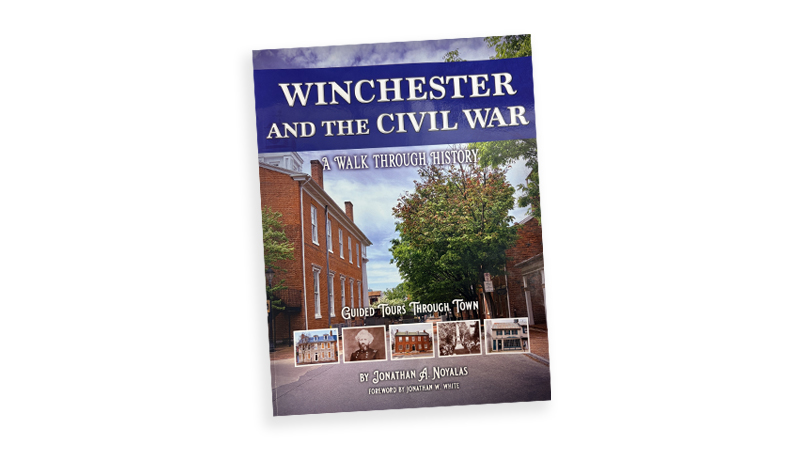
Explore 80 sites highlighting Civil War-era history in the upper Shenandoah Valley in Jonathan Noyalas’s book, Winchester and the Civil War: A Walk Through History. “My hope,” Noyalas wrote, “is that the stories of the people and places … serve as a reminder that the past is never truly behind us.”
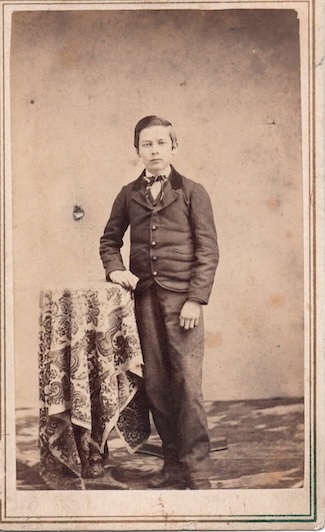
Private Arthur Wyant, a new recruit in the First Rhode Island Cavalry, could hardly contain his excitement when he arrived in Winchester, Virginia, in January 1865. As a teenage boy attending school in Ithaca, New York, prior to his enlistment, Wyant read about the conflict in as many newspapers as he could get his hands on. As Wyant kept himself informed about the war’s developments, he noticed the frequency of military activity in and around Winchester. Winchester, Wyant believed, had “probably seen more fighting than any place in the U.S.” When Wyant reached Winchester in early 1865, he took an opportunity to “walk the streets” to visit the places he came to know through newspaper print. As Wyant walked Winchester’s streets on January 25, 1865, he witnessed a community that had endured much. In addition to three major battles and dozens of skirmishes, Winchester changed hands scores of times throughout the conflict. This community, which one traveler described as “pleasant and hospitable” before the war, had become a shell of its former self. While some buildings, as Wyant wrote to his brother, were “mostly torn down,” those that survived bore the scars of incessant military activity or housed wounded and ill soldiers.
What mattered to Wyant was not the condition of the buildings, but visiting the places that he read about because Wyant, whether cognizant of it or not, recognized the power of historic places. Places are indeed tangible connections to the past, but they are so much more. Historic sites are, as preservationist Thompson Mayes noted, “mnemonic devices” that help a society not only remember its past but also provide a medium for conversations about history’s complexities.
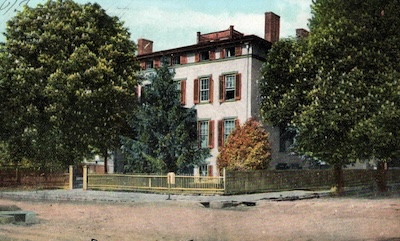
When I set out to write Winchester and the Civil War: A Walk Through History, I aimed, first and foremost, to craft a publication that highlighted sites connected to important moments in the Civil War’s history. This includes the residence of the Logan family, where Union General Robert H. Milroy issued “Freedom to Slaves!” on January 5, 1863, and announced to Winchester’s inhabitants his intent to aggressively implement President Abraham Lincoln’s Emancipation Proclamation. Milroy, an ardent abolitionist from Indiana, believed that the war for the Union could never be won until the pathway leading to slavery’s destruction was laid.
Additionally, I wanted to highlight places that revealed much about the complexities of Winchester’s Civil War-era history. While many of Winchester’s civilians supported the Confederacy, not all did. Approximately 10% to 15% of Winchester’s residents unflinchingly supported the Union. Numerous homes in Winchester’s downtown area reveal much about the strength of Unionism, but also the complexities of wartime loyalty. Samuel Trenary, whose wartime residence still stands on North Braddock Street, was regarded as one of “the chief Union men of Winchester.” Although he supported the Union, provided intelligence to Federal officers in the northern Shenandoah Valley, and aided Unionist refugees from other parts of Virginia, including the Richmond area, escape northward, he could not stand to see his Confederate neighbors suffer from shortages of life’s basic necessities. At various points during the conflict, Trenary, who owned a stagecoach business that ran from Winchester to Martinsburg, West Virginia, gathered what supplies he could in Martinsburg and distributed them to those in need, regardless of allegiance, in Winchester.
While Winchester’s Civil War sites offer much to think about, they also offer important perspectives about how individuals attempted to move on from the war. Sites in the downtown area such as the building where Mulligan Post No. 30 of the Grand Army of the Republic (GAR) met (it was one of four GAR Posts in the Shenandoah Valley) or the monument to the unknown Confederate dead in Stonewall Cemetery offer important insight into how former enemies attempted, however imperfect those efforts might have been, to heal the war’s deep and bitter wounds.
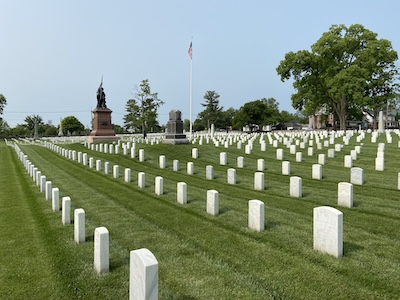
Perhaps most importantly, Winchester and the Civil War: A Walk Through History, through hospital sites such as the York Hospital, graves in the Winchester National Cemetery, including the grave of a young African American boy who provided intelligence to Union scouts in the autumn of 1864 and was killed by Confederate partisans because of it, and the final resting places of the Confederate dead in Stonewall Cemetery, offer valuable lessons in the present about the terrible cost that comes when people become divided to an unbridgeable point.
My hope, as I wrote in the book’s afterword, is that the stories of the people and places readers will encounter at the 80 sites in this book serve as a reminder that the past is never truly behind us – it is in front of us and beneath our feet, ready to inform, inspire, move, and offer valuable lessons in the present.
To learn more about Winchester and the Civil War: A Walk Through History please visit the Reedy Press website.
Jonathan A. Noyalas holds the Hugh & Virginia McCormick Chair in Civil War History at Shenandoah University and is director of the university’s McCormick Civil War Institute. He is the author or editor of 18 books including most recently Winchester and the Civil War: Walk Through History(Reedy Press). Prof. Noyalas has authored more than 100 articles, essays, chapters, and reviews for a variety of scholarly and popular publications. He has appeared on C-SPAN’s American History TV and has consulted on various projects for groups including the National Park Service, Shenandoah Valley Battlefields Foundation, and PBS’s popular series “Finding Your Roots.” Noyalas is the recipient of numerous awards for his teaching and scholarship, including Shenandoah University’s Exemplary Teaching Award for the First Year Seminar and the State Council for Higher Education in Virginia’s Outstanding Faculty Award.