Revived Roadside Motels for Nostalgic Travel
Checking in to the past in classic American motels
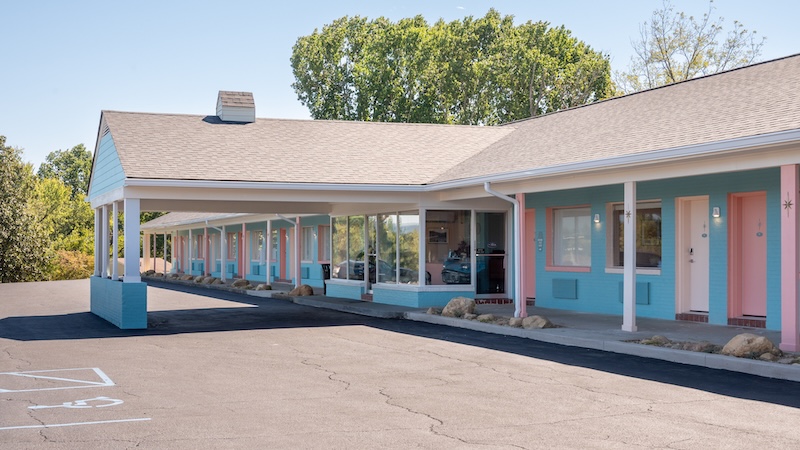
Set your GPS to these revived roadside motels with retro vibes, from classic motels that retain their original charm to renovated old buildings that celebrate the good ol’ days, like KG Motel in Lexington, Virginia (above).
If you traveled the U.S. 40 or more years ago, you undoubtedly recall staying in a motel – not a hotel, but a one- or two-story lodge, a motor court, where Dad pulled the family car just steps from the room. There may have been a swimming pool in the middle of the parking lot, a buzzing neon VACANCY sign, and a metal room key hanging from a plastic fob. You can still experience roadside charm imbued with nostalgia.
The motor court was built for the automobile age, when getting there was half the fun and roadside lodging promised convenience without pretense. Interstates, chain hotels, and changing tastes eventually sent many old motels into decline or to the wrecking ball.
But some survived — and nostalgia has become an asset.
NOTE: Some of these old properties are not fully handicap accessible. Call before reserving a room to check.
Nostalgic revived roadside motels
Across the country, travelers can once again check into classic roadside motels, ranging from remarkably intact survivors to carefully restored properties and full-blown retro fantasies. You’ll still find drive-up rooms and neon signs, but increasingly they come with Wi-Fi, good mattresses, and cocktails by the pool.
Some properties have undergone major renovations, but their owners deliberately retained enough original architecture and details to keep the old motel visible beneath the polish. Some old motor lodges have been updated over the years without losing the unmistakable character of the roadside motel. And some have been thoroughly reimagined with retro vibes.
KG Motel — Lexington, Virginia
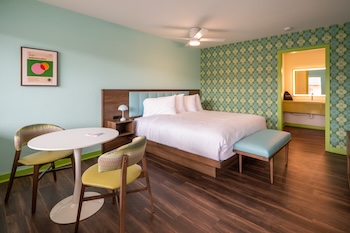
The newly revived KG Motel makes a particularly good example of how an aging motor lodge can be updated without erasing itself.
The original Keydet-General Motel opened in 1962, its name combining the mascots of Lexington’s two famous schools: the Virginia Military Institute Keydets and Washington and Lee University Generals. New owners took over in 2026 with an explicit preservation-minded approach.
Guests will be immersed in nostalgia from the moment they walk through the door and are greeted by a custom 1960 Ford Thunderbird check-in desk, a cozy Malm fireplace in the lobby, and vintage and replica midcentury pieces. Some guest rooms still have original bathroom tile and tubs, while replica laminate vanities were made to match the old ones. There’s drive-up parking, vintage furniture, atomic-age accents and, for guests who prefer the experience, even vintage-style motel keys. From the color palette to atomic nods, the experience sings nostalgia. Every guest room features furniture made in Virginia and stunning views of the Blue Ridge Mountains. The modern conveniences — smart TVs, charging stations, upgraded mattresses and Wi-Fi — are considerably less 1962.
Outside, a restored 1959 Shasta trailer serves drinks as Buddy Lou’s outdoor bar, adding another bit of roadside nostalgia and the twinkle-lit patio invites relaxation and reminiscing.
FEATURE PHOTO, TOP: KG Motel in Lexington, Virginia, among revived roadside motels worth visiting. Credit Barling Photography
Colony House Motor Lodge — Roanoke, Virginia
Even before you check in, Colony House announces its era with an old neon VACANCY sign and a striking roofline.
Built in 1959 along U.S. 220, the motel is an unusually intact regional example of Googie architecture, the futuristic roadside style influenced by the Space Age and automobile culture. Its folded-plate roofs, geometric gables, breeze blocks, swimming pool and eye-catching signage were all designed to attract passing motorists.
After nearly six decades of continuous operation, the motel closed in 2018. New owners undertook a lengthy restoration, retaining its defining midcentury architecture while updating the accommodations. It reopened in 2025 and joined Historic Hotels of America in 2026.
You can still park outside some guest rooms — one old-fashioned motel convenience that never really needed improving.
Stonewall Motor Lodge — Stonewall, Texas
The Stonewall Motor Lodge exists because a quiet corner of the Texas Hill Country suddenly found itself hosting presidential traffic.
After Lyndon B. Johnson became president, his nearby ranch — dubbed the Texas White House — attracted reporters, photographers, Secret Service agents, politicians and dignitaries to an area with very little lodging. Local residents Kermitt and Tillie Hahne responded by building the 12-room Stonewall Motel in 1964.
The property has since been restored and modernized while preserving its unmistakable 1960s roadside character. Few old motels can claim such a direct connection to presidential history.
The Verb Hotel — Boston, Massachusetts
An old motor hotel might seem out of place in densely built Boston, which is part of what makes The Verb so appealing.
The Fenway Motor Hotel opened in 1959, when automobile travel was reshaping American lodging even in cities. The low-rise modernist structure wrapped around a private courtyard and swimming pool, with parking convenient to guest rooms.
Rather than tear it down, developers reinvented the building as The Verb, using Boston’s rock-and-roll history as its theme. The old motor-hotel footprint and courtyard pool survived; vintage music memorabilia and a rock aesthetic supply the new personality.
Given its location near Fenway Park, you can indulge two forms of nostalgia at once: baseball and the great American motel.
For a different feel, check out Virginia historic hotels
Koolwink Motel — Romney, West Virginia
If you want to know what a family-run American motor court used to feel like, the Koolwink comes remarkably close.
The property began in 1936 as a tourist home, when Henry and Nora Klien rented rooms in their residence and two cottages to travelers. Their great-nephew Wallace Mauk and his wife Pauline bought it in 1955, expanded it through the following decades and kept the family operation going. Wallace designed much of the expansion himself and supervised the construction.
The Koolwink today describes itself as “a modern facility with a retro feel,” which sums it up well. Rather than being transformed into a luxury boutique property, it retains the low-slung motel layout and old-fashioned personality that make it feel like an authentic roadside holdout.
Sea Foam Motel — Nags Head, North Carolina

The Outer Banks may now be lined with enormous vacation houses and resorts, but the Sea Foam is a reminder of an earlier era of beach vacations.
Built beginning in 1948, the modest one- and two-story motel grew as improved roads and bridges brought increasing numbers of vacationers to the once-isolated Outer Banks. The National Register of Historic Places calls it one of the best-preserved surviving examples of the postwar motor courts that once proliferated along the barrier islands.
Today, the Sea Foam still looks and feels like an old-fashioned oceanfront motel rather than a resort trying to impersonate one. For Boomers who remember family beach vacations before three-story rental houses, that may be exactly the appeal.
Blue Swallow Motel — Tucumcari, New Mexico
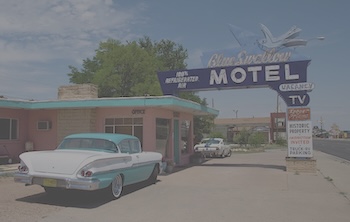
Few roadside motels deliver a stronger dose of Route 66 nostalgia than the Blue Swallow.
Construction began before World War II, and the motor court was operating by the early 1940s. Its pink stucco, Southwestern detailing, neon sign and individual garages between rooms made it a classic of the Mother Road.
Longtime owner Lillian Redman became part of Route 66 folklore herself, sometimes accepting personal belongings in lieu of payment or giving travelers a room when they couldn’t afford one. Even after Interstate 40 diverted traffic away from Tucumcari, the Blue Swallow hung on. It was listed on the National Register of Historic Places in 1993 and remains an overnight stop rather than merely a preserved roadside relic.
Holiday Music Motel — Sturgeon Bay, Wisconsin
Opened in 1952, the Holiday was Door County’s first motel, and many of its original features remain part of the experience.
Back then, amenities such as tile bathrooms, glass-block windows, modern furnishings and even a ventilated phone booth were selling points. Today those midcentury touches have become the attraction.
But the Holiday has acquired a second life as something more unusual: a gathering place for musicians and songwriters. The motel hosts collaborative music events and even operates a radio station devoted to music created there.
It’s nostalgia with its own soundtrack.
El Bonita Motel — St. Helena, California
In a Napa Valley filled with upscale inns and luxury resorts, El Bonita is refreshingly recognizable as what it is: an old motor court.
The property began as a religious retreat in the 1940s before becoming an Art Deco motel in the 1950s. Its low-slung buildings, retro architecture and vintage sensibility remain conspicuous on St. Helena’s Main Street.
That contrast is part of the fun. You can spend the day sampling world-class Napa wines, then return not to a lavish resort but to a swimming pool and a slice of roadside Americana.
Americana Motor Hotel — Flagstaff, Arizona
Built along Route 66 in 1962, the Americana has been transformed into a colorful version of what designers call retro-futurism — somewhere between The Jetsons and the golden age of the American road trip.
There is genuine history beneath the whimsy. When Easy Rider was being filmed in and around Flagstaff, Peter Fonda, Dennis Hopper and members of the crew stayed at and worked out of the Americana.
The renovated 88-room property plays freely with its 1960s roots rather than attempting a museum-quality restoration. It’s Route 66 as remembered through rose-colored — perhaps avocado green and harvest gold — glasses.
The roadside motel rolls on
These motels survived for different reasons. Some were lucky enough to remain in the same family. Some escaped demolition until preservation-minded owners came along. Others became fashionable again precisely because they looked so different from the standardized hotels that replaced them.
Their appeal isn’t simply that they’re old. It’s that they recall a particular kind of travel: pulling off the highway when you were tired, parking outside the room, carrying in one suitcase and perhaps letting the kids race immediately for the pool.
The old motel may now have a craft cocktail bar, luxury mattress and streaming TV. But step outside your room beneath a glowing neon sign, car parked a few feet away, and a little of the great American road trip comes roaring back.
Researched and written with assistance from ChatGPT