Tips for Visiting Carcassonne
The fortress city of your travel dreams
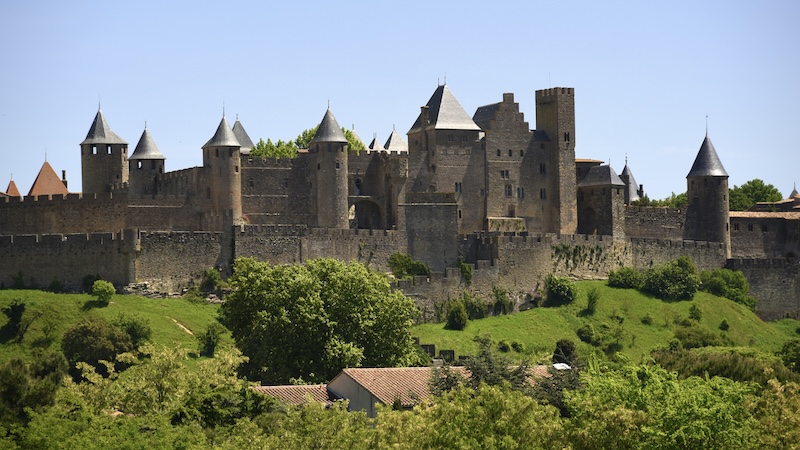
The fortified medieval town of Carcassonne in Languedoc, France, represents historic fortress cities of the past, many now gone. Travel pro Rick Steves offers tips for visiting Carcassonne, including when to explore and what to see and eat.
Sunny, out-of-the-way Languedoc stretches from the Mediterranean to the Pyrenees in southwest France. It shares a balmy climate, winter wind, grapevines, and the sea with the better-known neighboring region of Provence. To me, Languedoc is somehow more “France in the rough.”
I first came here as a teenager, when I visited Languedoc’s spectacular fortified town, Carcassonne. Sitting on the ramparts, I wrote in my journal: “Before me lies Carcassonne, the perfect medieval city. Like a fish that everyone thought was extinct, somehow Europe’s greatest Romanesque fortress city has survived the centuries. I was supposed to be gone yesterday, but here I sit imprisoned by choice – curled in a cranny on top of the wall.”
Anyone can feel like a kid on a rampart in this ultimate walled city, but it’s easier to savor its fairy-tale towers, turrets, and cobblestones if you don’t have to struggle with the midday mobs. By 10 a.m., salespeople are standing, poised eagerly, at the doors of their souvenir shops, creating a cheesy gauntlet of tacky temptations. But in the early morning, evening, or off-season, a quieter Carcassonne is an evocative playground for any medievalist.
The massive walls enfolding the old town are nearly two miles around, with 52 towers, each topped with a “witch hat” turret. For good measure, an outer rampart was added in the 14th century. While the double walls seem mighty enough, moats strengthened the city’s defenses even more. These weren’t actually filled with water and alligators – they were just a dry, dangerous no-man’s-land designed to expose attackers. The only way to beat a place like Carcassonne was a starve-’em-out siege. (Charlemagne supposedly tried it, but gave up.)
During Carcassonne’s 12th-century golden age, troubadours sang ballads of ideal love, chivalry was in vogue, and a pragmatic spirit of tolerance ruled. The area became a center of the Cathars – a heretical Christian group. They opposed the un-Christ-like materialism of the Church, which put them on a collision course with the pope.
But as France consolidated its central power, it clamped down on feisty groups like the Cathars, even in this remote corner of the country. The king and the pope joined forces to launch the brutal 13th-century Albigensian Crusades. The Cathars retreated to isolated strongholds in the hills, but in the end were ruthlessly wiped out. Today, the ruggedly beautiful land around Carcassonne is dotted with their haunting castle ruins – the closest are those at Lastours and Minerve (accessible only by car).
Scrambling around remote ruins and meditating on medieval life always whets my appetite. In Languedoc, I go for stick-to-your-ribs cassoulet. This regional specialty is an old Roman concoction of goose, duck, pork, sausage, and white beans. Be warned: “Going local” here can get you tripe (cow intestines) or foie de veau (calf liver). Whatever you order, wash it down with one of the region’s well-made wines.
In these parts, the Cathars were also called Albigensians – named after the nearby town of Albi. This enjoyable river commune of sienna-toned bricks and half-timbered buildings has two world-class sights: a towering cathedral and the Toulouse-Lautrec Museum.
Albi’s big and bold St. Cécile cathedral is hard to miss – locals claim it’s the biggest brick cathedral in the world. It looks less like a church and more like a fortress. In fact, it was a central feature of the town’s defensive walls. Built during the height of the Cathar heresy, this place oozes power: Get on board or get run over, was the message.
More to see in visiting Carcassonne
Next to the church, the Toulouse-Lautrec Museum contains the world’s largest collection of artworks by the famous hometown boy. Born in Albi in 1864, Henri de Toulouse-Lautrec was crippled from youth. His father, once an engaged parent, lost interest in his deformed son. Henri drifted to the fringes of society, where he gained an affinity for other people who didn’t quite fit in.
He later moved to Paris and made his mark painting the city’s underclass. His candid portraits – of winos, prostitutes, and cabaret dancers – are uniquely colorful and graphic. His advertising posters for Paris’s theaters and dance halls were his bread and butter, and today are some of his most recognizable works. He died at age 36, unmourned and unappreciated by the art establishment. Luckily, the mayor of Albi had the good sense to accept his artwork when his heirs offered it to the city.
Languedoc’s hard-fought past and independent spirit are evident everywhere – in its landmark fortified city, ruined castles, hearty cuisine, and go-it-alone art. Venture to southwest France to discover this distinctly local culture.
PHOTO CAPTION, TOP: With its 52 towers, witch-hat turrets, and nearly two miles of ramparts, Carcassonne is France’s ultimate walled city. Rick Steves offers insights into visiting Carcassonne. CREDIT: Cameron Hewitt, Rick Steves’ Europe.
 Rick Steves (www.ricksteves.com) writes European guidebooks, hosts travel shows on public TV and radio, and organizes European tours. This column revisits some of Rick’s favorite places over the past two decades. Read more European adventures in For the Love of Europe. His latest book, “On the Hippie Trail: Istanbul to Kathmandu and the Making of a Travel Writer,” reveals journal entries from his 1970s journey, which ignited his love of travel and broadened his perspective on the world. You can email Rick at rick@ricksteves.com and follow his blog on Facebook.
Explore more of Rick Steves’ Europe in Boomer
©2025 RICK STEVES