‘Remembering Roots’ Revisits the TV Classic
How ‘Roots’ captivated a generation and helped transform the world
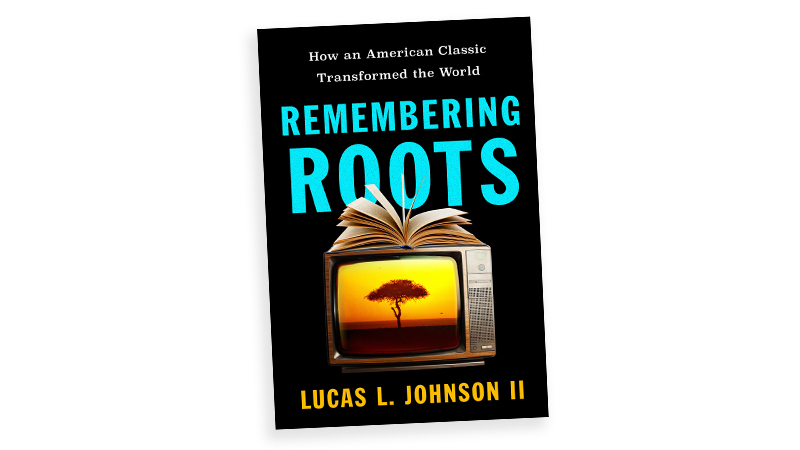
Alex Haley’s Pulitzer Prize-winning novel, Roots, transformed lives. Released in 1976, it was soon followed by a landmark television adaptation, which aired on TVs across the nation in 1977. This Boomer book review looks at Remembering Roots: How an American Classic Transformed the World (June 2026), as journalist Lucas L. Johnson II looks at the legacy of Roots and people influenced by its message.
If you were watching television in January 1977, chances are you remember Roots.
You may remember gathering around the TV night after night, talking about it at work, school, or with neighbors. And you may remember the sense that seemingly everyone else was watching, too.
For eight consecutive nights, ABC aired the sprawling story of an African family torn apart by slavery and of the generations that endured, survived, and ultimately gained their freedom. By the final episode, more than 100 million Americans were watching. Television rarely brings Americans together that way anymore. Even then, Roots was something extraordinary.
Nearly 50 years later, journalist Lucas L. Johnson II revisits that cultural phenomenon in Remembering Roots: How an American Classic Transformed the World. His book looks not only at Alex Haley’s groundbreaking 1976 novel and the landmark television miniseries it inspired, but at what happened afterward: the conversations Roots started, the interest in genealogy it ignited, and the ways it changed how many Americans thought about slavery, ancestry, and family history.
For baby boomers who remember the original broadcast, Remembering Roots offers both a trip back to a remarkable moment in television history and a fresh look at why that moment mattered.
The story behind the memories
For those who haven’t seen Roots in decades – or at all – the miniseries begins in West Africa with Kunta Kinte, portrayed as a young man by LeVar Burton in the role that launched his career.
In 1767, Kunta is captured, forced aboard a slave ship and transported to colonial America. There, he is sold into slavery and subjected to repeated attempts to rob him of his freedom and his identity. Even after being ordered to answer to the name “Toby,” he clings fiercely to the name given to him by his family. John Amos later takes over the role as the older Kunta.
The story continues through Kunta’s descendants. His daughter, Kizzy, played by Leslie Uggams, is sold away from her family. Her son, Chicken George, brought memorably to life by Ben Vereen, becomes another vital link in a family story passed from one generation to the next. Eventually, the story carries the family through the Civil War and emancipation.
That multigenerational sweep was part of what made Roots so powerful. Slavery could no longer remain a distant institution summarized in a history textbook. Viewers came to know individuals and families: parents separated from children, husbands from wives, people struggling to preserve names, memories, and connections despite a system designed to destroy them.
The production itself was packed with familiar faces. Along with Burton, Amos, Uggams and Vereen, the cast included Louis Gossett Jr., Cicely Tyson, Madge Sinclair, and Maya Angelou, plus Ralph Waite, Sandy Duncan, Lorne Greene, Ed Asner, Lloyd Bridges, and Chuck Connors. Gossett’s Fiddler, who befriends and helps the newly enslaved Kunta, became one of the miniseries’ most memorable characters.
ABC executives had reportedly worried about whether viewers would embrace such difficult material. They needn’t have worried. Roots became one of the biggest television events in American history, ultimately winning nine Primetime Emmy Awards.
For those old enough to remember the broadcast, however, ratings and awards tell only part of the story. What stands out nearly half a century later is how thoroughly Roots entered everyday conversation.
Suddenly, everyone was looking for their roots
In Remembering Roots, Johnson explored what happened after Americans turned off their televisions.
Roots helped spark an enormous popular interest in genealogy. Americans who had never thought much about family history began visiting libraries, archives, and courthouses, looking for birth certificates, census records, marriage licenses, and other traces of the people who had come before them.
Even the word “roots” became part of the popular lexicon for conveying ancestry, heritage, and the search for where our ancestors came from.
Boomers who caught the genealogy bug in those years may realize that the research was even more challenging then. Haley’s own ancestral search seemed to suggest that, with enough persistence, family stories buried by time might still be recovered.
Importantly, Remembering Roots does not simply celebrate Haley without qualification. Johnson addresses the controversies that followed publication, including challenges to some of Haley’s historical claims. Acknowledging those complications makes the book stronger. The author also shares the struggles that Haley faced in completing the soul-wrenching epic.
Why Roots still resonates
What emerges most clearly from Remembering Roots is just how much one book and one television miniseries changed the way many Americans talked about the past.
For Black Americans, Roots placed Black family history at the center of a prime-time national television event on an unprecedented scale. For many white viewers, the series presented slavery with an intimacy and emotional force they hadn’t encountered in popular entertainment.
And for viewers of every background, it reinforced a simple but powerful idea: our ancestors’ stories matter. Johnson looks at the influence of the “behold” scene (echoed years later in The Lion King, as Rafiki lifts Simba the cub skyward). He explores the power of our names and our chosen identities, of family treasures, and of family. Significantly, he describes how Roots opened many minds to the realities of Black life in America across the centuries.
Cast member LeVar Burton captures that idea beautifully: “Remembering Roots highlights the indomitability of the human spirit; and reminds us that, like our ancestors, as long as we continue to breathe, there’s hope.”
That message helps explain why Johnson’s book feels timely rather than merely nostalgic.
The voices of Remembering Roots
Within his book, Johnson shares the pages with scholars, genealogists, artists, students, authors, members of the original cast, and the words of Haley himself. Feast your mind and soul on forewords by Black scholar and activist Raymond A. Winbush and professor of American studies Gayle Wald. Read a generous, moving excerpt from the original Haley book and personal thoughts from LeVar Burton, Blair Underwood, Halle Berry, Leslie Uggams, Sandy Duncan, and others who played essential roles in the production of the miniseries.
Today, genealogy has become more commonplace and convenient, but the basic questions haven’t changed. Who came before us? What did they endure? What did they pass down? And the answer remains: knowing the past in its entirety – the pain and evil as well as the joy and love – is essential to a better future.